

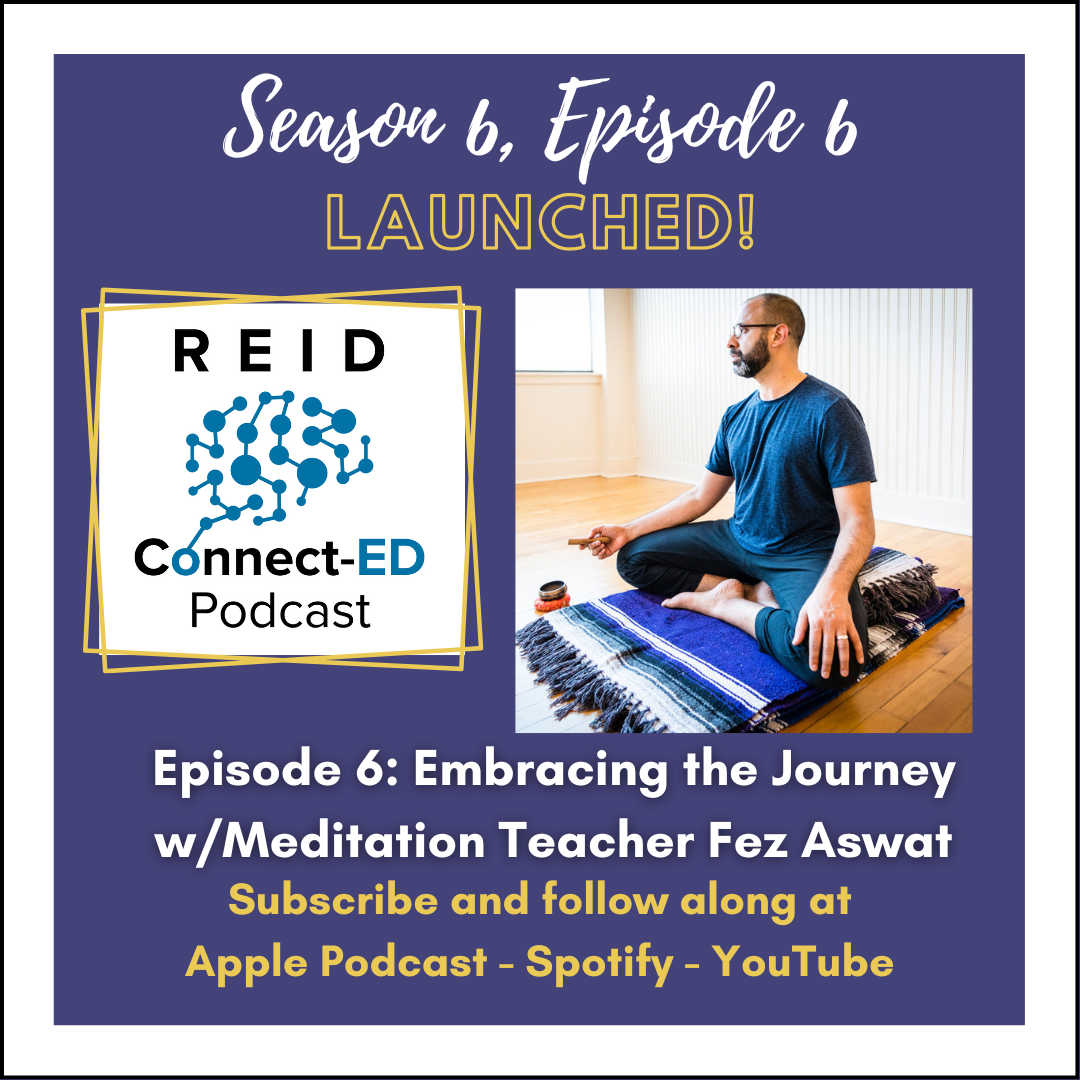
S6 E6: Embracing the Journey w/ Meditation Teacher Fez Aswat
Listen Now!
-
Fez Aswat
Fez Aswat is a meditation teacher and coach for individuals, teams, and organizations. He is the co-founder of bostondharma.org where he teaches online meditation classes and retreats.
Fez’s coaching focuses on the application of meditation, Buddhism, and yoga as a set of systems and practices to approach daily life. In addition to his rich 1-on-1 work, he has worked with groups such as Division 1 NCAA teams, social work organizations, foundations for youth at risk and incarcerated people, health care workers, artists and arts organizations, corporations, small businesses, financial institutions, economists, and academic institutions. Fez provided the guided meditations for the FocusCalm.com app utilized by Formula 1 Racing, the US Bobsled team, and professional athletes from tennis, the NFL, Major League Baseball, and Premiere League Rugby.
Fez began teaching in 2000 and has taught meditation and yoga at many of the most beloved centers and studios in Boston. He continues to mentor yoga teachers individually. He continues to work closely with his mentor, Tom Alden. His Buddhist study and practice is with both the Theravadin and Mahayana traditions. He has learned a great deal from renowned yoga teachers Barbara Benagh and Patricia Walden.
Beyond his purposeful work, Fez is a happy husband, a proud father, a professional musician, a two time cancer survivor, a middle aged cyclist, and he loves his dog and where he lives.
-
Fez explains how music was a lifeline for him early in life. He discusses how an unexpected connection led him to learn a song on the guitar, leading to a lifelong passion.
Fez discusses how meditation felt like finding a well that was nourishing for him.
Fez discusses how it’s important to remember how to lead from the heart instead of the mind.
Gerald and Fez compare the similarities between meditation as a way to connect with the inner self as Internal Family Systems (IFS) Therapy strives to do.
Fez discusses the idea to break free from ‘afflicted narratives’ through relationships (which maybe helped us at a certain point in time) that shape our thoughts and reactions. He explains how meditation is not necessarily a ‘pleasant experience’ but rather helps people to work through the unpleasant challenges of becoming still, which may only happen in fleeting moments or at the end. Afterwards, when he goes back into his day to day life, he feels more at one with himself. In other words, he feels more connected to his inner self following this meditation practice.
Fez discusses the ‘if-then fallacy’, such that we think that ‘if only’ we can achieve or get something in the future, then we will feel ‘okay’; however, contentment often comes from being present.
Fez discusses how when you organize yourself around the inner goodness through meditation it ‘softens the edges’ that comes with those afflicting narratives. And the will to exist to live through that inner goodness comes out naturally.
Fez discusses how experts are the ones who acknowledge how much they actually do not know. When it comes down to it, Fez sees helping others as one person genuinely, willingly, and intently caring for another and seeing if that type of help, including the person’s own faculties and own learning, will resonate with the person. As such, he sees that people can utilize meditation in their own way that works for them.
Fez talks about how yoga and meditation training and learning is an ongoing process.
Fez describes how there are many different versions of what meditation is and means. For some, it can be an intellectual exercise, others consider meditation as a completely silent exercise, and so on.
Fez describes meditation as how the mind can make things harder or easier within the context of stillness. At the same time, he does not think there is one definitive answer for what meditation is. Gerald shares how this is similar to trying to define therapy in the ‘perfect’ way, even though there are some similarities across therapies and meditation practices.
Fez and Gerald discuss how in a meditative state, the mind can expand and have space where creativity can emerge naturally as opposed to the typical narrowness of focus that we can fall into in our day to day lives.
Fez talks about how he works with collegiate athletes helping them to learn stillness as a way to ground themselves. He shared his personal experience of playing a sport within two different mindframes and how actually the consequences were drastically different. Gerald shares with Fez how athletes’ motivation (e.g., trying so hard to win) may actually keep the athlete out of the moment. It can also pull athletes away from the joy that can come from playing as they lose touch with that part of themselves.
Fez talks about hockey is 2/3's seated meditation and how resetting yourself is it’s own skill.
Fez finds meditation to be helpful in the practical sense after the meditation happens.
Gerald shares how working in therapy with patients is very much like a meditation, creating a space to be present and safe to sit with thoughts, feelings, and experiences.
Fez shares how his own meditation practices allows for him to be the way he hopes to be others when teaching meditation to others.
Fez and Alexis share how Fez’s teacher Tom describes how we are learning how to ‘tune’ ourselves to the present, like an instrument. Fez explains how we get better and better at the ‘fine tuning’ (hearing the subtleties of being out of tune) as we continue our meditation practice. He explains how it is much like an instrument needs tuning over time, it does not stop.
Fez shares a story of a high level jazz musician who once shared a lesson how he practices by doing the scales the same way others practice - going back to the beginning. Fez and Alexis talk about “begin again” as the first instruction of meditation practice, and something we always have to be reminded of… to ‘begin again’.
-
Alexis Reid 00:00
Music. Welcome back to the ReidConnect-ED Podcast. Today, we're joined by Fez Aswat, who is a meditation teacher and coach for individuals, teams and organizations. He's the co founder of bostondharma.org where he teaches online meditation classes and retreats. Fezzes coaching focuses on the application of meditation, Buddhism and yoga as a set of systems and practices to approach daily life. In addition to his rich one on one work, he has worked with groups such as division one, NCAA teams, social work organizations, foundations for youth at risk and incarcerated people, healthcare workers, artists and arts organizations, corporations, small businesses, financial institutions, economists and academic institutions. Fez provided the guided meditations for the focus com.com, app utilized by Formula One racing, the US bobsled team and professional athletes from tennis, the NFL, Major League Baseball and Premier League rugby, though we're not going to have you go through all the meditations here today, people are gonna have to check out the app to hear you. Fez began teaching in 2000 and has taught meditation and yoga at many of the most beloved centers and studios in Boston. He continues to mentor yoga teachers individually. He continues to work closely with his mentor Tom Alden. His Budd study and practice is with both the Theravadin and Mahayana traditions. He has learned a great deal from renowned yoga teachers, Barbara benow and Patricia Walden, beyond his purposeful work, Fez is a happy husband, a proud father, a professional musician, a two time cancer survivor, a middle aged cyclist, and he loves his dog and where he lives, Fez, we're so happy to have you here with us today. I'm happy to be here. Thanks so much. Thank you, Fez, so this is really cool, because we were just talking before about how you and I know each other and have had a relationship for probably seven or eight years now through the meditation and yoga world. Yeah, that sounds great. And we got, you know, thinking about silver linings through, you know, the pandemic that shall not be named. We got to really deepen our work together, because I was so fortunate to take you on as a teacher and a mentor and a guide. Take you on. You took me on as a student, however you want to phrase it, I feel so fortunate for that time where you were really like a guiding light to help me navigate through some of the most challenging storms, and also helped me to remember how to stay grounded and anchored through some of the most challenging times in my life, both thinking back and reflecting on things historically, and also going through that time where you and I both really showed up for so Many people to help support them through this very unusual circumstance called COVID. Yeah, so our time together goes back a long time, but we often don't see each other in person once
Fez Aswat 03:32
a year. That's what I was telling Jerry, really, yeah. I mean, before zoom. I mean, I didn't know what zoom was until the Friday of the shutdown.
Gerald Reid 03:40
BC, before COVID, before COVID,
Fez Aswat 03:43
before times. Yeah. Maggie said, why don't you do your Sunday class on Zoom? And I said, What's zoom? And she said, it's really simple. She told me about it. I just said, I'll get you a Venmo account. I said, What's Venmo? And I didn't know what it was. And and then that first class on Sunday at 537, people showed up, and it was, you know, remarkable, and then I shifted everything like within one week, but I found that over the course of that time, where I was seeing people on that two minute, two dimensional screen over and over again, I needed to connect with people at least once a year to remember that they have contours and profiles, and, you know, an energy that you can feel like that you don't have to reach through a screen to be able to sense. So, this is our once a year. This is
Alexis Reid 04:30
our once a year. Yeah, and I don't know if you and Jerry have sat in the same space to be able to have a conversation
Fez Aswat 04:35
we've never hung up before, right? Like in passing and just a sort of pleasant life, hello, goodbye.
Alexis Reid 04:44
So pleasantries aside, I think it's a really special relationship to even share that, even though we don't see each other in person so frequently, there's this really nice bond that is so special to me and same I just really appreciate. Appreciate you coming to talk to us today, because not only do we have a special relationship and connection, there is so much that you have taught me and you've taught so many others, and really, just truly getting to know you and your story and how you've gotten to the place to do the work that you do now is just such an inspiration, and here on our podcast, we have a lot to share from a didactic, pedagogical perspective through our expertise in our work, but it's really not about like things and theories. It's about our lived experiences and helping the audience and other people who might be going through really tough times, understand that there might be different options and ways to navigate through life. And I have been just blown away. And I'm in such awe of all that you have lived in, how you carry yourself and how you've committed yourself to helping and reaching so many others. And you know, we joke about COVID and zoom and digital technologies, but really it's extended your reach. I think it has, at least for us, because I could have never made it to all of the the meditation lessons that you offered, because I was often working at the same time you were working running those running those sessions. So I was grateful to be able to have that access. And the other part of my work is also about creating access to learning and opportunities. And I I really want to highlight and showcase some of the work you do, but before we get into all of that, if you feel comfortable, I would love for you to share a little bit about your journey and how meditation and yoga, and we'll talk a little bit more about music too, how that has really fueled, inspired and guided your path in life. Sure, it's a big question, yeah, um, maybe we can start with just how you even ended up here in Boston. Oh,
Fez Aswat 06:55
um, interesting. Growing up in Los Angeles was was very intense for me. It was the 10 most difficult years. I was born in Canada and then moved to Los Angeles when I was seven, and then lived there until I was 17, and I found that culturally it was just a hard space for my parents and I to navigate. I've always thought that I would if I ever wrote like, a memoir of that time, it would start with the story of the exit off the freeway, which is what we call it. I now, I like, I've been in Boston for 30 years, so I only think highway. I remember, like they say freeway on that side in
Alexis Reid 07:33
Jersey, it's Parkway. Oh, really.
Fez Aswat 07:38
And but getting off the freeway, off the one on one on one. The exit from my house, there was a Shell station and my senior year of high school, my senior year of high school, there were the riots after running King. There were fires. There was the Northridge earthquake. We had a death in our in our class, and just a very strange year. And in that year, the s of the Shell station on the exit would go out very periodically, so when you were getting off of the freeway, it would just say, hell. That was pretty funny, but it was a Yeah, it was just a rough place. And my two best friends were heading to the East Coast, and I wanted to get out here, and like I was telling you before, I wanted to get as close to Berklee College of Music as I could, because I wanted to play music, and wasn't allowed to go to music school. So I went to the school that was the closest distance from there, and then eventually did get there. And so that's why I came out here, in terms of meditation. I mean, I can't tell you how I got into it, yeah.
Alexis Reid 08:47
Well, we'll go there in a second. But I was just thinking as you were telling that story, it's so interesting just to think about, you know, familial perspectives and how sometimes, you know, when a parent or a family might, like, point a child in one direction
Gerald Reid 09:24
based on their own, whatever perspective they're going exactly. It
Alexis Reid 09:29
may actually move them towards that, or it might move them in the opposite direction. And for you, in thinking that you weren't allowed to go into music, right as a profession and a career moving forward, that actually drew you closer to it. So
Fez Aswat 09:42
I got really good at practicing bass without plugging in. And I would, I would close the door and put my chin up against the body of the bass so I could hear it reverberating through my head to practice bass. That was my experience with music that I kind of fight to be able to be a musician. Yeah,
Alexis Reid 09:57
there's something about that. And you. I'm titling this episode, embrace the journey, because I think it's so fitting for like, the story of your life. And as I know you and I am looking forward to hearing more, because just hearing you say I learned how to play bass by unplugging and putting the bass up against my body, like there's vibrations there, and those same vibrations come up. A lot of meditation and embodied practice too, which is kind of interesting. As you
Fez Aswat 10:26
said, that different rhythms, yeah, right, yeah, that's interesting. Yeah,
Alexis Reid 10:30
very much. So it sounds like music's
Gerald Reid 10:31
very meaningful to you, yeah,
Fez Aswat 10:33
it was a lifeline. I think maybe still is, but it was definitively a lifeline that got me through. I think my my practice took over after a while as that which is getting me through, and I think it's been very helpful to have practice be the overall context. And music is something that sort of exists within a larger, larger view. I guess when music was the whole of the view, for me as a younger musician, was too fused with like the dreams and ambitions of a, you know, a younger person. Did
Alexis Reid 11:10
you just feel it inside of you that you needed to create music, that you needed to be a musician? Was it something you were drawn to that way? Or I don't
Fez Aswat 11:18
know that it was that stark. It was just that we were playing music. We're listening to music. There was I went to a lake house with a friend, and he and his brother each were allowed to invite friends, and he invited me, and his older brother invited some guy who was just a bully, just a terrible human being. And I still remember the guitar. He had a Kramer guitar and and I had one interaction with him. I have not thought about this person in so long. I had one interaction with him where I said, Can you teach me to play something on the guitar? And he taught me to play the intro to a song called Sanitarium by Metallica. A note to you guys remember the song and and he said, The zo goes. And I sat there plucking away at it, and within 20 minutes, I thought I could not believe that I could create the same sounds of a song that I listened to over and over again, and I sat there the whole weekend just repeating the same riff over and over again. And my friend was annoyed with me because we weren't, you know, doing lake house, starting playing ping pong. We weren't running around, you know, I was just sitting there on a guitar learning to play the same riff over and over and over again. And I was just mesmerized that I could make those sounds. And so I don't know that I was called to it. I think it happened very accidentally. Like, in some ways, it said, you know, like, for a moment the bully broke through, and, like, had this connection. And, yeah, that's never really thought about that, but I just really liked it. And I kind of got obsessed with trying to ask my parents if I could get an instrument, and they said no for a long time, and I borrowed discarded guitars that people had in attic certain closets for a while, and it was an acoustic guitar for a while, with the strings that were like a centimeter off the fretboard. And I learned to play under the bridge by the chili peppers night guitar, and then eventually borrowed a Stratocaster, and then eventually my mom got me a bass and and we thought we would, you know, we're little metal heads. And then I was thinking I would play bass and sing, which I did for a little while. And then when I started playing, I stopped listening to metal completely, and shifted into I got, like the Bob Marley box set, Santana Abraxas, the James Brown's Greatest Hits, and the police box set, and I just learned all of those songs just on repeat. And then I could not sing and play those songs at the same time the police was I could, because it was designed for that. But I stopped singing after that point, and then I was like, I guess I could play in bands, and that's where it came, came from. That's awesome. Yeah,
Alexis Reid 14:03
very cool. Yeah. It's so interesting. And I think at different points in our life, especially during adolescence, when we are introduced to music, sometimes it resonates in a different way, because it's just this developmental time point where we remember the most, because our brains are developing at a rate that's much faster, it feels
Fez Aswat 14:23
so big, yes, and I sometimes wonder if it still, if it still does or or if it's faded, like did music feel bigger when we were in our teen years? You know, fascinating.
Alexis Reid 14:36
It's so interesting. I think, you know, I, I would venture to guess that from a neuroscientific perspective, it's not that it feels bigger, it's just that our worlds are smaller because we have fewer experiences. And when we're experiencing that, sometimes it feels so big and it's new because it's new, right? We don't we don't know any better. So
Gerald Reid 14:56
can we relate this a little bit? I do want to get into. Your journey. But I'm just like, dying to ask this question of like, how the experience of music, that profound experience they had, just playing the guitar or just playing music, relates to meditation. It's
Fez Aswat 15:14
a really hard subject for me, because it didn't relate to it for a really long time, and I'm still exploring what the relationship between the two things are. I think the word meditation is used often with not enough specificity, because it means so many different things to different people, right? You know? Whereas, if you know, if you talk to a Christian mystic, you know about what meditation is, they're gonna, they're gonna regard it as a contemplation, right? It's a very active intellectual process, you know, if you take, you know, Marcus, Aurelius, meditations, they're, they're written essays, you know, whereas in the Buddhist form, when you're talking about meditation, meditation is a, it's a very quiet practice. It's sort of as silent of a practice as it is, you know, a silence that precedes sound as it were. And so that's one view of meditation. The other thing that's very difficult for me was I found both meditation practice and yoga practice as responses to stress that I was feeling out of the lifestyle, and, you know, the lifestyles and practices of a young musician. So I was practicing, you know, was on my instrument, like five to six hours a day in various different settings, from practice to rehearsals to, you know, gigs to recording sessions. And I was also very stressed out from this facet of trying to figure out how to just functionally be a, I mean, I guess at the time, like a 20 year old person in Boston, you know, and those things gave me enough of a mental need to look for something to ease the difficulty. So I went to meditation practice and yoga practice, completely separate from from music. Actually, I failed one class in college. And this is a true story that the one class that I failed in college was called awareness training, and I would go, I went to the class, and there was a guy who would teach in a very, very low, monotonous voice, and he would have us practice sort of guided meditation, lying down, and I would be out cold within four seconds. And I remember thinking, I don't know why I'm going to this class to take a nap when I could take a nap at home. And so I wound up staying at home, and I wound up failing the class. But it felt a practice. It felt like a practice that was I had to start with it as separate from everything else, because I needed a practice that felt separate from the rest of my actualized life, you know, and that maybe benefit, beneficial, isolating. Practice of meditation was able to it felt like going to a well, like just when I might be depleted, I was going to a place that was nourishing me in a way that I didn't know I could be nourished, like the idea that silence was nourishing, and the idea that stillness was nourishing was very new to me at the time. And so when I would emerge back into my life, I didn't quite know exactly what the connection between the two things were, but I did find initially, it was helping me exist better. And then I would go out in the world and be exhausted, and then go back to my cushion and go back to the mat. And so they were very separate for a really, really long time, and I wanted, I was constantly looking for a teacher that could tell me what the connection between the two were. I wanted the way that I felt in meditation practice to correlate and relate to and inform whatever I was doing in my life. And that's eventually how I found Tom, because I found that a lot of the teachers who are going I was going to could discuss what was happening on the matter on the cushion and yoga and meditation, respectively, or they can talk about the philosophy, or they could talk about what you're supposed to do in those settings. But I would constantly say, I don't know what this has to do with my life, and there also wasn't a lot of room for me to ask those questions until I met Tom, you know, and Tom's who was Tom. Tom is my teacher who I started working with, and I think it's 2004 he thinks it's 2003 we just had this conversation I'm like last week, but his predominant interest was in how to understand. And the connection between meditation practice and the rest of your life, you know, and you know his template is basically you begin with meditation and then you formulate a means of thinking that is based on how you're thinking in scripture or how thinking occurs in meditation practice, because it does naturally occur in meditation practice, gradually towards the the questions of how you use the meditation practice to open one's heart. You know, even right now in this conversation, I can get very cerebral and very intellectual. So it's very hard to remember. I've got to figure out how to make this go from the brain south into my own heart, which this dog is very helpful in reminding us, right, that this is a this is a heartfelt practice, and then taking it from that into does that inform your behavior, right? So I needed those links to find the connection, and now I'm gradually starting to see how my my music practice is an expression of a me that existed. I think even prior to practicing music, I think everyone comes in with something, right? Everyone comes in with an you know, you see children, you know it was so it's so interesting having a child, because you're constantly like, when they're born, you have no clue who they are. But my daughter was, she was three months old, and I was holding her, I was like, I don't know how to relate to this thing. Like, I could know more about you in a 30 minute conversation than I did with my daughter for quite some time, because I could hold my daughter and be like so what are your likes and dislikes? You know, who are you? What do you think is funny? And they don't. They're not expressing that like cerebellum, yeah. So in some ways, you're kind of getting to know them while they're getting to know themselves at the same time. And then there was when she started smiling and started relating to me, and she started gesturing for me, like with her arms and her legs. Then Then I started to get to know her. I do believe that there's almost like, you know, the yogic view might say that there's an impulse that is being reincarnated into another lifetime, right? So it's this idea that a personality precedes the way a person exists in this incarnation. Now, do I believe that that's true? I don't really know. You know, is a personality simply an expression of a set of neurological happenings? I don't really know, right? But I do. I do have this sense, and I've always had the sense that there's a part of who I am that sort of precedes the way I look. It precedes what I'm saying. It precedes, you know, the experiences that I'm having. And I've come to understand that music, for me is a way that some inherent goodness to who I am is making its way into expression. And it might even be not, it might not be as an expression for the world. Thus so far, I don't know it is the amount of stuff I have on Spotify that doesn't get listened to. Means, I don't know that it is for the world. It is released, but it is expressing something out there, maybe even for the purposes for me to understand who I am through those things, you know? So now I'm starting to see that the beginning point for me is the meditation practice, and then can I filter it through, into into playing, into creation, into speaking, into relating with other people. I
Alexis Reid 23:49
love that you said that, that we all come into this world with something, because it's actually
Fez Aswat 23:53
a Tom line, really, yeah, Tom. Tom said this two weeks ago. He said all, he said, all of us come into this world with something, and I think it's good for us to know what that thing is. And we also come into the world, not with some things, and it's important to know what those things aren't
Gerald Reid 24:12
things that shape us through experiences, yeah, well, I think,
Alexis Reid 24:15
I think that's how you know, at least in our family, this is kind of how we were raised, right to see a goodness that everybody gets to offer and share with the world. Yeah, and that it's partly just what we're born with, because there are so many different types of people in different families who might have similar values but express themselves so differently, but they're like you're saying, Jerry like, through a matter of experiences, that spirit, that light, whatever you want to name it as that we bring with us into this world can get shaped and transform. And you know, depending on the practices that we find helpful to guide us through the challenges or the learning opportunities, I think can transform the experience. Science. I think that's what makes you know, Jerry wrote an album called Mosaic. It's like all the different pieces that come together that are a part of us to make something beautiful, which I think is really interesting.
Gerald Reid 25:11
Yeah, I'm hesitant to say this, because once I say that, it's gonna maybe change the course of the conversation. Sometimes, when I'm doing therapy with people, I'm like, don't, don't ask this question. Just let the thing just keep going. Don't say anything. Actually, I'm gonna say it for the sake of the audience of like, learning about mental health and stuff, because it's very related to what you're saying. Different types of therapies suggest this is happening. There's a, there's a particular therapy called internal family systems therapy that specifically says this is what happens, is that very much what you're saying is that we all have a self that is in its purest form, full of creativity, compassion, connection, love, presence. And it sounds to me that when you meditated, you felt that purely, more robustly than ever. When you found meditation, then you're saying, like, it's great to bring that into your natural life, as well as when you're meditating. And the idea behind this therapy, and many therapies, is that that self gets protected from pain with parts that protect us from the pain. And the protectors could be things like, you know, like running away or being like, overly controlling or under controlled. And the idea of the therapy, of the therapy is to actually let those protective parts that are protecting us from the pain we've gone through to kind of step back so that our natural selves can re emerge and lead rather than the protective parts taking over and leading us. And it's a whole really fascinating therapy of like, developing a relationship with those protective parts to understand, Oh, you're just trying to help me, like you can It's okay, though. There's no pain right now, right now, you can step back. We can just be and just really resonate me with what you're saying is, I mean, thank you for being so open about the pain that you felt as a kid. It just seems to resonate so much with this idea of like meditation allowed you to step into your inner self with those protective parts stepping back.
Fez Aswat 27:10
You know, you said one thing that is interesting in the meditation practice, I'm frequently not feeling a connection to that pure essence of me. It's a very, it's a, you know, one of the predominant scriptures that meditation practice is informed by in the yoga systems, is a scripture called the Bhagavad Gita, right, which might be one of the earliest sightings of internal family systems, right? It's a and it basically, if you take the whole thing as an analog for a meditation practice, it's saying, within the context of meditation practice, you're, you're, you're fighting a battle, right? And it really kind of feels like that. You know, meditation is not wholly peaceful, like it looks peaceful from the outside, right on the inside, you're going, how do I negotiate these seemingly quarreling parts of my own mind with one another, right and and so what's happening is, if you take the the reference point of ifs, or if you take the reference point to the Gita, what happens with the main character, Arjuna, the meditator, if you will. The self is saying the battle scene is paused so it takes place within a battle. And his charioteer, his the chariot driver is, is Krishna, who he finds out through the process, is actually God, right? He just regards him as like his chariot driver. And then they're like, Hey, I'm actually God, right? But he has the capacity to pause the battlefield. And he says, I want to see who I'm fighting before I go to battle with who I'm fighting. And he learns that who he's fighting, as you know, people that have raised him, close family members, friends, you know, people that he's loved his whole life, right? And he says to Krishna, Arjuna says to Krishna, I can't, I can't fight these people. And these are the people that I've been so close to my whole life. And you know, Krishna says, You must fight and destroy your friends and family, essentially. But it's basically like the scripture that is, it sounds very violent in nature. It's saying like, like, the whole point is we might be overly identified with aspects of our own mind that don't help us, like we espouse these narratives that maybe helped us at a certain point in time, but in time they become like, you know, your friends from college that are still partying like they're in college, when you're trying to get like, you know, a good night's rest, and it starts to feel like, you know, a weight that's holding you down. And so the idea. Is to, you know, the encouragement is to say, how do you do away with these afflictions, or these afflicted narratives like that's kind of where it comes down to. So if you talk about that, right? The feeling of meditation is not this pure, angelic, blissful state where you're looking at a lightness that seems to be shining through a prism, and you are the prism like that, doesn't it sounds great, right? And there are moments where it is really pleasant, but oftentimes, sometimes the most beneficial meditation practices I'll have will just be like, 40 minutes on the battlefield of like, you know, between the parts of me that want to feel okay and the parts of me that want to keep me entrenched in my own difficulty, right? My own sort of mental anguish, excess mental anguish, and and because you're working it out, sometimes it takes 40 minutes, and it does work out. And oftentimes, the first instruction is, bring your attention to the breathing. But it's 40 minutes of I can't pay attention to my breath because this battle is exhausting. I can't breathe. And then 40 minutes later, you go, and you go, Oh, there's the breath, right? So you can come out of a meditation practice that was unpleasant, but still feel a little bit more like yourself. And that's what I was getting from meditation practice, right? The first meditation retreat that I sat at a very renowned meditation center in Western Mass it. It was a terrible experience. I hated, like so much, of this first retreat, and it was at the time like they didn't have singular dorms or single dorms, so you had to have roommates, and I did not want to be on a meditation retreat with another person in my space. So I decided to camp and and I'm not a camper, right? So I had driven cross country and I camp. Camped on that trip, but I didn't know, like a lot about it. And I got there, it was mid July, and it rained every single night, and it was extremely uncomfortable. And, you know, I'm sitting still for I mean, I think the meditation hours logged in, or somewhere between like four and 10 hours of meditation a day, and your body hurts like you wouldn't believe. It's a really strange setting you're with. You know, 200 strangers that you are not speaking to. You're sitting in a dining hall listening to people chew, you know, and just clanks of utensils and whatnot and and it was really uncomfortable, and I didn't enjoy it. I was like, I don't know why I'm doing this. The first night I was if it was maybe the second or third night, I was debating whether or not I was going to leave the retreat, and I was walking towards my tent, and I was thinking, I need a sign. Like, if there is some divine power, I need some sign that, why to do this? Why not to call my then girlfriend, my now my wife, and say, like, hey, come pick me up, because I can ride there. It's like, I don't want to do this. And this was actually two weeks after I met Tom. I met Tom right before, and Tom actually helped build the retreat center. Oh, wow, that I was sitting at, I didn't know that. Yeah, it's kind of, it's kind of crazy. So I was walking, and I was like, there's no sign I gotta get out of here. And I was walking, and I saw a meadow, and the meadow was just covered with fireflies or lightning bugs just covered, and I'd never seen one in my entire life. Wow. And I was like, All right, I'll do the meditation. I'll do it, you know? And so I stuck it out, and I did the best to understand the philosophies, and I did the best I could in the meditation to try to correlate what I was hearing in the philosophies to the meditation practice. And you know, there was an insistence on that meditation practice to not write anything. But you know, since I was by myself in my tent, I wrote a lot. I still have the notes from there, and when I left, I remember being in the car and getting in the car with the two people who I was there with, David Vendetti. Do you know who that is? He's another yoga teacher in town. I was him, Todd scoglin and me, and I left thinking, like, I'm so glad to be out of that retreat center. It was like prison. And when I got back to Boston, the first thing I did was I had a rehearsal with my band, and every song we played, we'd finish it, and I'd be like, that was the best version of that song we've ever played. And my bandmates would look at me and be like, really, really, think we got it. And I'd be like, No, that was easily the best we've ever played that song. And what I found for the week that I was back was I felt more like myself than I had ever felt like probably in my entire life up until that point, and I to this day, I spent so much time after that saying what occurred in that practice that the. Yeah, that was as comfortable as as, as uncomfortable as it was. The result was that I felt more like myself, right? Which is fascinating, since no self or non self is such a central part of the practice, which I don't talk a lot about as a teacher. Do
Gerald Reid 35:15
you think it was simply the intention being activated?
Fez Aswat 35:18
Intention being activated. I don't think it was. I think what was happening was there is a predominant narrative that comes through in meditation practice, which is the underlying feeling of, I want to feel okay. Yeah, right. And it's this revealing the meditation practice can reveal that that feeling of okay is inherent into your experience, if you can quiet all the other factors that tug and pull at it or convince you that you are not that okay. And you know, even that sounds overly simplistic, because there are genuinely times where you're not okay. You know, people in going through incredible adversity, you know, for whatever the reason is, are genuinely not in a place of, okay, so the that experience is very real. But if you're in a space of relative safety, you know, like we are here in the Sabbath, you know you're in a space of relative safety, you close your eyes in meditation, the first thing that's there, the feeling of okay, is not there immediately, right? What's there immediately is all the narratives of a series of experiences that are pulling and tugging saying, you know you're okay is elsewhere. You know you have to do this before you're okay. You know that? I think we've talked about this. I call it the if then fallacy, this ongoing belief that if I can accomplish x, y and z, then I'll be okay, which is like, you know, the carrot that you're constantly chasing to every catch. And so what happens in meditation practice is your identification with those narratives softens, and your identification with the part of you that wants to be okay, and at least, at least in that constructed setting, you're trying to find it within yourself starts to become a little it starts to get a little higher in the mix. And so you start to go, oh, the capacity to organize, but you feel more agency, right? That you see, like, it's a very strange thing, where people think, you know, I can't control a lot, but I can control how I respond to things. And then you do this meditation practice and you're like, I can barely control that either. But I think so. I don't think it's necessarily intention, per se, I think what happens is you're organizing yourself around that lighter part of who you are, whether you know it or not, and because you're trying to do that, it does soften the edges that come with a lot of those other narratives. And I think with that lighter part of you, that's where intentions and the will to exist in a way that feels expressive of and from your sense of goodness, I think that comes forward a little bit more nice. That's my that's my sense of it. I'm
Alexis Reid 38:16
so glad you brought up the idea of intention, because I think a lot of people go into meditation or spiritual practice or study, looking for something with the goal of something that comes from it. And Jerry mentioned ifs which is from the clinical perspective of helping to understand family systems and how we feel within them, and in a lot of the clinical practices you and I have talked about this, a bunch have drawn from some of the Buddhist teachings and practices to bring it into this idea of what we constructed as Mental Health here in in our Western society. And, and I think it's so interesting. And fez a lot of why I wanted you had to come on this, this show and have this conversation is because I'm constantly grappling with my role in sharing with others practices that could be helpful, right? Because my version of what's helpful might not be the same as others. And in research, as great as it is to be empirically based in things that we do and say from a scientific perspective, you know, not everything is going to work for everybody all the time. And I think through media and conversation and expertise that's so frequently and easily shared everywhere, a lot of people think I need to do this too, right? Going back to this idea of if then Fauci right, like if I do this, then I'll feel that. And I kind of want, I love your perspective on meditation and spirituality, and I appreciate our work and teachings. But that aside, you know you have such a real way of thinking about how to navigate through different aspects of life, and that was part of your process that led you to meditation. And I wonder if you can share you know, what you have heard from practitioners or students who have come to you saying, I want to learn about meditation. Can you teach me or I want to feel better? Can you help me to get there, or what that experience has been as a teacher in your role to help and guide and support people on that journey.
Fez Aswat 40:23
I'm going to refer something that you said once in a session that I thought was really amazing. You if I take some of the specificity out of the conversation, but you said, you said, you basically said something to the effect of, I pretty much am just the same person that I've always been, but now I have a set of credentials that identifies what that thing is supposed to be. But it's like, I don't know, you do have letters after your name couple. I have no letters after my name, right? They're just letters. They're just letters. Actually, I did a, I did a thing for this corporation that was, like an HR thing before, and they were writing the check to me, and they said, so are you, like an LLC or something, or are you just a guy? Like, I'm just a guy. But isn't that true? We all are just that. That's what I want my LLC to be called. If I, if I just the guy. LLC, right. Reference back. Hello, Rafa, so you said, and I really liked it. You said, like, the thing that I do is a thing that I've always been able to do, but now that's right, Rafa, the thing you said, the thing that I do is the thing that I've always been able to do, but now the world just calls it something. I think that's how you said. It sounds good.
Alexis Reid 41:48
Sounds about right? Yeah, it's and.
Fez Aswat 41:51
But essentially, what you were saying was that the central principle is just one person caring about another how another person feels right. And one thing that I'm noticing as we get older is you can have people who are experts at this and experts at that, and experts at this, and they did this study, and they did this training, and they did that training. Can sound really intimidating, but when it comes down to it, it's just like, like, person one and person two, and can you help each other? Like, that's all it is. Yeah, right. And the reason, and I just like, I really have a hard time with the word expertise, because anyone who oftentimes, like, like, the foremost experts are fully aware of how much they don't know. Yes, right? So you take like, I saw, I saw an interview. I don't know if I saw it or I read it, but it was on Jacques Cousteau. And the interviewer said something like, you're Jacques Cousteau. You're the foremost expert on oceanography. And he was like, it's the ocean. He's like, I might know some things about the ocean, right, but what I don't know far, far exceeds the little that I have learned about the ocean, right? Yeah. And so I find this thing where it's like, if one person is just willing to care for another person after that point, what happens is they will actualize any skill set that they have, any personal faculties, anything they've learned, anything they saw work for someone else, anything that worked for them, to figure out how to express care in a way that hopefully helps the person, and I think that's all it is. And the way that I have learned how to care is through these practices that I've learned from other people who decided to share them with me from a standpoint of care, right? And so it's like, you know, no one's parents are the same, but they're all just trying to figure out how to care from their own set of personal faculties, personal experiences, and also through their own flaws, you know, are trying to mitigate how their flaws can neg adversely affect the work. So that's kind of my view of it. You know, I'm not sure if that answers your question, but
Alexis Reid 44:22
no, but I not exactly. But I think it prefaces it in a really nice way, because we had a conversation with Dr Ellen Hendrickson, who wrote this really great book about how to be enough for self critics and perfectionists, which rang true for a lot of me and the work I do with the people that I work with, too and their experience. I should listen to that one. And she was sharing a little bit about she said, you know, in our world, where everybody is an expert, right? You go on social media and you see these people telling you what the right thing is to do. And I think, you know, in meditation, it's been a beautiful thing to see the scientific research on how helpful meditation is. And. In the US, we've kind of taken that and ran with it and integrated it into a lot of places in life. And you and I had this conversation before where I feel uncomfortable sometimes sharing my work and practice with others, because as much as I know I don't know so much to your point, you mean specifically about, specifically about meditation, and you know, the philosophy behind it, and the 1000s of years that have gotten to the point where we know of meditation as it is today, and you shared so astutely and wisely to me that it doesn't actually matter. It matters what's helpful for people. And to your point of, you know, we're all just finding some shared components of life to help each other with. I think that's a really beautiful thing and a really beautiful place to think about. You know, meditation doesn't actually matter. It's about what you're going to find helpful for you in a moment.
Fez Aswat 45:57
Well, the accuracy of the technique I'm saying, or the delivery of the technique doesn't matter, like I always find it to be. I'm not saying it doesn't matter. It does matter, yeah, but I'm saying, if you're spending five minutes with, you know, a kid that you're working with just trying to get their nervous system to settle, yeah, whether or not you're doing it in the same way that I would deem correct or incorrect, doesn't matter, as long as that kid's nervous system settles a little bit. You know that it meets your objective. I think it's fine. I always find it's helpful for newer teachers to remember that when they start teaching, their teachers are not there. So even though, when we're teaching, we often imagine our teacher there, always,
Alexis Reid 46:34
I always do I hear your voice in the back of my head. And for the audience, I went through a nine month training with Fez and as Burton and Ryan to learn how to be a better meditation practitioner and student myself, so that I can share that with others. And it was so funny. I came out of it telling Fez. They said, You know, I thought I'd be feeling more confident and ready to go, and I don't want to teach meditation ever, because I know what I don't know now do that,
47:03
dude, we tried so hard to
Alexis Reid 47:06
my own internal system, right? You could hear my own like, self critic within me saying, like, okay, you know, you you know. I also want to honor the practice, and I want to honor the history of it, which makes it tricky. But I think to your point, what you find helpful is what is important, right? Not that something doesn't matter, but that the knowledge of every aspect of it is not as important as the skill, the tool, the practice, that is helpful.
Fez Aswat 47:39
And I also think studentship, right? So I think one of the most important thing for younger yoga teachers and meditation teachers is that I've always just thought of myself as a TA,
Alexis Reid 47:55
right? Well, you have an incredible teacher. I mean, Tom is like, right, so
Fez Aswat 48:00
thank God I have a professor. Yeah, right. But I started teaching at such a young age and so frequently had the feeling of like, I don't really know what I'm doing, you know, I don't, you know, people are coming to my meditation classes. And I was in my, you know, 20s, and I felt like the practice was bigger than I than I unders, you know, relative to what I understood at the time. But the way things work in our culture is like, if you show up to a room and people give you money all of a sudden, it's a thing that you're doing, you know, and it was a better way for me to get a check than other ways that, you know, were available to me. But you know, the most important thing for me was to be clear that I didn't there was a lot that I didn't know. And so for me, it was not only respectful for people coming to my classes, but also to the cultures from which these practices come from, to continue to study. And one of the things that I saw happening through the advent of the 200 hour yoga certification and the weekend trainings and etc, etc, was that people thought that their training just occurred in that time during that and then you'd see a lot of teachers that would stop learning after that point because they thought their learning was relegated to that, you know, 200 hour time, or 300 hour time, where I think it's really important to sustain continuing to study and continuing to study. And I think when you do you it's impossible to ignore the cultures from which this comes from. You
Gerald Reid 49:36
know, especially like in society, how like, there's such an emphasis on progress and progressing and innovation and newness, as you're saying that, like sometimes that, like, first of all, it could have, like, the opposite effect. We have side effects from trying to do that too much. Secondly, like, sometimes the answers are there. We just have to kind of study them and realize. That they're already there in some ways, some of, at least some of the answers for us. Yeah,
50:04
yeah, totally, totally.
Alexis Reid 50:06
I think you know, you mentioned for younger yoga teachers and meditation teachers. I think that's a great lesson for pretty much anybody, for parents, for educators, for coaches, for athletes, for just humans in general, right? That it's not necessarily about the progress or the constantly raising the bar for yourself and whatever you're aiming to do, but really just having that deep reflection and curiosity to learn more, and that's a big part of the way in which you teach in our work together, especially, too. It's not just about learning and applying a framework that makes sense in a moment. It really is about the introspection and the reflection. And if you feel comfortable, you're welcome to share. You know, our our work together, has shifted and changed over the years too. Can you
Gerald Reid 50:57
share? I just went for the for the listener. Like what I feel like, we gotta pull back for a second and like, can you operationalize or kind of describe, like, what meditation is? I feel like, we kind of skipped over that step
Alexis Reid 51:11
and like, Yeah, we were making a lot of assumptions that the audience knows what.
Gerald Reid 51:14
And I'm really curious. I'm gonna, like, let you maybe address this at some point. But like, since I work with athletes, and, like, there's a there's like, Phil Jackson kind of pioneer the idea of, like, meditation, mindfulness for athletes. And since then, sports psychology has adopted the idea of mindfulness is, like, a really important part of sports performance. So maybe, as I know, you've done some stuff with athletes too, maybe you can at some point get there. But if you, like, put the listener just to kind of like in your words, I mean, like you said, there's different versions of what meditation means. But like, if someone were to want to try to implement mindfulness or meditation, like how it looked like an elevator, kind of speech for someone listening,
Fez Aswat 51:53
when I first started practicing a lot of meditation, I used to say the basics of meditation practice were, sit down, shut up and figure out how to get interested, right? I think I used more colorful language than that, and but, you know, I thought of it fundamentally as a practice of stillness, and I thought of it fundamentally as a practice of stillness where you were trying to calm yourself. And then eventually try to understand how to see your mind clearly, and how your mind would make things make the moment harder, or how your mind could make the moment easier in the context of stillness, wakeful stillness, that was how I fundamentally understood it right now is that the definitive what meditation practice is. I don't think there can be a definitive like saying what meditation practice is
Gerald Reid 52:55
like trying to say what therapy is. There's so many ways of explaining what therapy is.
Fez Aswat 52:58
Yeah. I mean, you can distill things down to pithy ways of describing them. You can say therapy is, you know one person who is predominantly focused on another person's psychological and emotional experience and trying to support them towards having a less painful, right, psychological emotional experience. So there are pithy ways of understanding it. One of the one of the ways that I teach meditation when I'm on a training, if I'm in a 200 hour training or 300 hour training in the yoga setting, is I will I realized there was a certain point in time where I was showing up to a training and no one had any idea who I was, and it was, like, six months in, and there's a sort of, I used to call it the hubris of the second year grad student, where, like, you get this, like, the second year grad student has done so much study that they believe that they understand things that everyone doesn't see. And so they'll, like, sit in diagnose everybody. They'll sit in on a on a session with somebody who's been a practitioner and, you know, for 1015, years, and they'll be, like, assessing whether or not it's right or wrong. And so there's something there's really very similar about, like, the second half of people in certain trainings. It sounds so cynical, but it's the same thing where I was going in. I was like, six or six. There was six months in. I was like, I'm going to go in and they're going to be sizing me up the whole time. And I just had a weekend with them, and I thought, I have to figure out how to instruct meditation practice that they've already done plenty of in some way or another, in a way that doesn't try to affront their understanding of what they believe it to be, right? So this was, these were the parameters, when, when, when Ryan and I did the, the, the called a meditation immersion and instructor training. So. Um, Ryan is my teaching partner, and Ryan Cunningham, really great. Yes, so, but we use this as the template when we're saying that, um, there were five, there were five elements to look at in meditation practice. And one is, what is the context right? Which means many things. And one of the contexts that you have to look at is, is there a philosophical view that informs how a person is meditating, right? And the truth is this idea of an introspective practice to bear some type of I'm just gonna use the word spiritual in a very open way. Benefit is not it's not a word that any one culture or a practice that any one culture has the monopoly on, right? So even in the Buddhist diaspora, there's the theravadins believe that meditation practice is as So, right? And there's but even in just the Theravadan view, depending on the monastery that a monk is in or the teacher that a monk is working with, they'll be very dogmatic about the little differences, right? You know, whereas your Tibetan Buddhists have a different view of practice, or different way of practicing, versus your Zen Buddhist and versus, you know, your Sufi mystic, that's going to say, Okay, well, we're doing this for these reasons. So, so the word meditation, you have to understand what context is a person coming from in the in the practice, right, which takes a little bit of inquiry in terms of the person. Right? For me, the way that I practice came from a set of influences, right? So contextually, what are the influences that make it meditation? And then the commonalities are, every meditation breaks down to, what is the position? Right? Like, is, is this person going to be sitting in full lotus? Right? For the Sufi mystic that's trying to have a meditative experience by, you know, spinning, they'll arrange their body with their arms, that, like, so, you know, with their sights above, so that they can do something. If somebody's practicing a yoga practice, right? The position is different. Put your hands here, put your arms here, etc. Then there's what are the various ways you can pay attention. And then there's your intention, right? And so the intention is varied based on who's doing what. And then it comes down to the technique, right? So if somebody knew nothing about meditation practice, and they wanted to try it right. He said, what's the simplest way for you to describe it? I would go back to what I said when I was a younger practitioner, which is like, just sit still, right, close your eyes or don't right. Can you be still? And can you pay attention to your body, how it feels in a moment to moment way, and then Can you calm it enough so that you notice when your mind is making the process harder and when your mind is making the process easier? That's it that is most distilled, in my view, but that is still also within the context of the way that I learned to practice. And it might be something very different for you know, a friend of mine is very kind of deep Christian practitioner, and for him, the stillness and the embodied experience is less than the sort of playing with the cognition. It's very much a reflection exercise for him, but that's what meditation is for him, or that's what meditation is, for me, it still comes down to what a person wants it to be.
Gerald Reid 58:44
You know, that's amazing. Couldn't ask for a better answer, long, winning answer. It explains it quite well. There's so many similarities to therapy. Like I teach a counseling theories class, we go through all the theories, and at the end of the day, we're like, you know, they're all their own version of this, and there's some things that overlap and there's some things that are different, and it's good to kind of just learn about all of them and see what's going to resonate for the person and work for the person, as you're saying.
Fez Aswat 59:14
But that's really the most important thing, right? That if you're sitting there with a person who's having a human experience, your theory is less important exactly than just what that person is experiencing,
Gerald Reid 59:26
and research continues to suggest that the relationship is a big factor of whether or not therapy helps people. Yeah, and I remind the students that you are the context in which healing happens. It's not the therapy, it's you create the context for healing to happen. It says awesome explanation. Fez Aswat 1:00:34
Well, I mean, in I think what happens is a like, it's something that we talk a lot about in classes in our practice, is making that which feels impossible possible, the unworkable workable, right? And so oftentimes what happens is, I think in meditation practice, what's happening in time is your the mind starts to recognize that there is more space than the narrowness of how you might look, how you might be looking at something, and or maybe it's the same amount of space, but you're held by certain patterns less it's hard to tell you can visualize it either way. But what happens is, anytime there's the felt experience of a little bit more space in that space is creativity. And so sometimes that's where this stuff comes from, you know, the Eureka. I found it, you know, well
Gerald Reid 1:01:36
said. So I want to bring in the athlete aspect, because so much of athletics, I think, is creativity, particularly in a sport like basketball, soccer, hockey, or just where there's team dynamics, there's openness, there's like a flow to what happens. So tell us about your experiences working with athletes, and how this type of mindset and just way of orienting your consciousness you know, could be helpful. Or,
Fez Aswat 1:01:59
yeah, I think, you know, some of some of this goes back to the if then fallacy that we're talking about earlier. But I work with the northeastern Huskies, and I love them dearly. I've been working with them for the past six years, and the support that I know the best is hockey, which is, you know, I only lived in Canada for seven years, but the hockey stayed and and I do find that one of the things that's really helpful for me as a practitioner. And you know, I didn't do this stuff when I was a kid, and I was playing a lot, but I do now. But, you know, I had this experience playing hockey, and I was in kind of a cranky mood, just like a crabby mood, and I showed up and I was like, I need a win today. Like, I really need a win today to feel okay, right? And that was, like, historically, when I was a younger person, that was a green flag for me, or, like, a checker, yeah, that was green, you know, like, not a checkered flag, a green flag to go full tilt. But oftentimes, when you're operating that from that place, you're, for me, like you're you're operating with a sense of agitation, and that agitation can impede the finesse of whatever you're trying to do. I can kind of keep you out, out out of the flow state, as it were, and so as soon as I caught it, now it's a red flag. Now it's like, okay, if I think I need a win, that means I gotta take a few steps back. One thing that I really love about hockey is, on my view, hockey is two thirds seated meditation, right? Because if there's three lines right, three lines, and everyone's dividing their time on the ice right, and you're spending two thirds of the of the game on the bench waiting for you to jump back on and do your third right. So you're in seat of meditation for two thirds of the time. What you're doing, what you're processing, what you're trying to figure out how to do, how to reset yourself. I think that's its own skill, right? I don't, I don't know how many teams will say, what is the skill of being on the bench before you jump back out? You know, as its own thing, can we practice that we're gonna have you all sit on the bench, and that's we're gonna practice this time, right? But I caught it when I was out there, and I was playing desperate. I was playing agitated, I was playing angry, I was playing frustrated. And then I got back off the ice, and I was like, wait. Well, why do you do this? You know, I started playing hockey again in my 30s because I had finished a cancer treatment. And between when I left my home, between like 18 and 28 I didn't play hockey at all. I think I played hockey maybe like five times. I played club at BU and I was talking about this last night. If anyone knows Boston, Rob from survivor. If you watch Survivor, you might have listeners who know him. I played with him. He was like, Intro. Celebrity on survivor from survivor, but I only played for like, five times, and I stopped playing hockey, and after cancer, I wanted to go back to reclaiming a part of my youth that felt like was a really important part of me. I was like, Oh, so that's why I'm here. I don't care if I score a goal, right? My rule to myself in my 30s, was like, if I don't get injured, it's a win, right? And I was like, Okay, so I'm here to just feel like myself, to feel happy, being myself, right? The first time I was back out on the ice, just the sounds and the smell of hockey made me happy. And now it's like, I need a win. I need to score, to feel happy. And I was like, those, those don't work, right? So I started figuring out how to get out of the head space of the desperation that comes from winning into sort of more transcendent experience of just hockey being the way that makes me feel alive. So I was doing all these meditative practices on the bench waiting to jump back on the ice, and I jumped back on the ice, and I scored two goals
Gerald Reid 1:06:02
naturally, yeah, oh, my God,
Fez Aswat 1:06:04
not going for the win is making me play better with so much joy just enjoying it again, you know? Yeah, like, it doesn't matter. Like, no one, you know, it's like beer league hockey. And I jumped back out the ice, and I was meditating more, and I was doing different practices and techniques that I've learned along the way, and I jumped back out and I scored another goal. I had a hat trick for the day, which is really great, you know. So I do think getting out of the headspace, that keeps you out of the moment in a natural way, is a major part of meditation practice that can benefit the athlete. Working with the NCAA rowers, one of the main things that's important to me with them is they're like 18 to 22 years old, and so in some ways, they're all wanting to do really well in their sport. I'm just wanting them to be okay as people. Like, I'm seeing them a little bit more as people and thinking like, you know, it's a support where, like, you know, nearly 100% of the time I'm the only non white person in the room, and so I'm wanting to have a positive relationship with this demographic of you know, young men that could move in a direction of organizing their lives with, you know, an influence of more peace. You know, oftentimes what happens in sport is there's a lot of team dynamics, which I find really interesting, like just how to work with them and team dynamics, and how do they organize around working together to enhance and empower themselves and one another, rather than a lot of this sort of bravado and support that keeps them out of staying focused. You know,
Gerald Reid 1:07:52
I love your story because it's it just shows again, like when you can pull, when you can pause, as Alexis always says, pause and understand what your goal is, what your intentions are. It shifts everything. And like, sometimes athletes will, like, Come to me, like, I just want to calm down. I want to get rid of my anxiety or whatever. And really it's pulling back and understanding what's motivating them in the first place. Yeah, and shifting that perspective is a big thing. Just like what you said,
Fez Aswat 1:08:17
yeah, that was a thing. Going back to the music piece. That was the thing that I lost as a musician, because I had a lot of, I think, beginner's luck as a musician, I was on, like, my first gig, there were 400 people. My second gig, there was like another 250 people and and then it just as a young musician, I was in these positions where, like, I was seeing, like the success, and I got to the point where I forgot about that adolescent feeling of music. And for me, the connection of meditation with music started to be I wanted to go back to how much I loved that feeling when I was younger. But it's the same thing you're talking about these athletes is like, once they start to correlate their aptitude to getting something from the world, it, it can sort of, you know, mask or cover or completely destroy the fact that there was a kid in there who just loved playing stuff, Yeah, you know, from joy to fear, yeah, yeah, exactly that. I
Alexis Reid 1:09:23
think that there's just different, like, stages and phases of life where we get So, like, acutely focused on, like, building our skills and doing our best, that we lose track of that and then to reclaim it. But I think what you're saying is, if you can find some sort of practice that's helpful to bring you back to the reason why you're doing that thing. It can allow that experience to transform into something beyond, maybe even what your intention or expectation
Fez Aswat 1:09:53
is. And I find meditation to be so helpful because it's really hard of a meditation. To correlate what you're doing to the success that you can gain from the outside world, from it, right? It's really hard to sit in a meditation practice and be like, I'm going to become a great meditator. So I can get on the Reid Connect Podcast someday, and then maybe someone will listen to it and they will hire me to become, you know, meditation guru to rich people. That will mean I can get my kid through college, right? Like, like, you can do that in a meditation practice, right? I can sit there and I can do that, you know, I've there are meditation there's, there are meditation teachers who, you know, teach in settings that are,
Gerald Reid 1:10:42
you know, are violent. I'll just say, like, they're I don't want to say I understand what I'm saying, or to, like, optimize something when, yes, like, you're just you're contributing to their problems.
Fez Aswat 1:10:53
This comic that said, like, I don't know if it's a New York Times comic or something, but it said it was like this high powered businessman, and he says, like, with just nine minutes of meditation a day, I have what it takes to conquer the world. And behind him is this, like, you know, you know, popper sitting on the floor, saying, with, maybe, with an hour a day, you won't feel like you need to, you know, like, it's like, that kind of a joke. I was
Alexis Reid 1:11:16
just visualizing, like somebody meditating with a fire around them, and then people from the outside saying, Just stay calm. Just stay calm. It'll go away. It'll get better. It's like, no, the fire's still gonna burn.
Gerald Reid 1:11:28
Well, I love it. There's so many parallels of meditation that I feel like in doing therapy with people, it is a meditation in many ways, even though it's not a formal practice. Meditation, being calm with someone, allowing them to sit with their thoughts, their feelings, and to feel contained and safe while doing so and present is the older I get. Is like it is the most, some of the most enriching, fulfilling, meaningful experiences like I've ever experienced in life. And it's not even about me, it's about the other person in the therapeutic, yeah, like, providing that space for someone is like, it brings me to tears sometimes thinking about how important it is to have a space to do that, especially nowadays where, like, people have a phobia of being present, because it's like, everything you're saying, it's like, we're not conditioned to be present anymore.
Fez Aswat 1:12:20
There's a lot of stimulus, you know, just, just a lot of stimulus. But, yeah, I mean, I think the thing I was saying, I think I didn't actually get to the point, but, like, was, when you sit in a meditation practice, at some point you realize it's just you and you, and that's a really hard thing to connect to what you can get, that you can accumulate, right if it's just you and you, you have to really use the faculties of how do I make this experience better? And related to the therapy and also to the to the one on one work is my capacity to feel a sense of inner competency in that way, becomes the template of how I sit with a sense of care when I'm with another person you know,
1:13:08
because
Fez Aswat 1:13:10
the you know, the relationship has its own dynamic, but I have to be so clear about how I'm doing internally. And that reference point goes back to the cushion, you know, your superiors, yeah, well, it's interesting, you know, I, I know a lot more about Alexis meditation practice and less about yours, but hearing you talk about how you begin the day in prayer and meditation, and I do think that that, that, you know, my teacher would refer to it as inner competency that you're practicing there becomes the intelligence from which you practice competency within yourself when you are relating to a client at the same time. Yeah. So I think it's, it's a, it's an, it's an integral practice, but I think it's the ultimate reference point of how to support others. You know, I
Alexis Reid 1:14:02
think you brought up so many really important themes just in life, right? Thinking about finding the things that bring you joy, that stimulate you, that enrich and nourish you in your life, from early on, finding ways to bring that into your life, across the lifespan, being able to find the practice or the tool or the strategy that allows for you to show up in presence for the work that you do, while holding on to the sense of self. And this thing we call identity, right, whether it be in the role of a hockey player or a musician or a teacher, remembering that it all comes from this internal spark that we bring with us, that we show up with, that we can tune right you and Tom. I love the terminology that you use about tuning to our own presence, like an instrument, almost like an instrument, right, like that we can tune to. To adjust and to adapt to different circumstances while still holding true to ourselves. And I think it's probably one of the most important messages for us in this life, because there are so many things that we can't control, but the thing that we can control is always within us. It's always with us, and that's what I find so helpful with meditation that even if, for me, if I don't have time to sit for 20, 3040, minutes, I can still take those few minutes to return to my breath, to return to my inner sense of self, to be able to tune a little bit differently, to be able to show up for whatever comes next. Yeah. I
Fez Aswat 1:15:40
mean, I think the experience of just being a person, and I think the more adversity that we experience as people, it's like, the more it's like you become an instrument that becomes far and far more temperamental, that goes out of tune faster and quicker. And so glad you said that and, and the the necessity to retune an instrument over and over and over again, you know somebody who plays a stringed instrument is is, I think, what the meditation practice is, you know, and, and then the other thing that happens is, you know, the Better you are as a musician like you can, you can hear the subtleties of being out of tune like a lot better. So to a certain degree, one, it's like getting in tune enough so that you can actually play right getting in tune enough as a person, so that you can actually exist as a person. And then after that, it's the fine tuning. It's, you know, a lot of, a lot of musicians get their sound, you know, some, some musicians get their sound by not being perfectly in tune. You know, I heard a amazing story about how Keith Richards knew the fraction of the detuning of his own guitar, which this is, there's a, there's a story behind this that I have to tell where I had a guitar player friend who said he kept trying to play this one Rolling Stones part well, and he couldn't do it. And then finally, he saw a live clip where somebody handed Keith Richards a perfect, perfectly in tune guitar, and he started playing, and it didn't sound right. And he detuned two of the strings a little bit to get it to sound right. And he realized, Oh, the way that he got that sound was two strings were not perfectly in tune, but he you know. And that's that fine tuning, wow, for effect, you know. And I think initially, as you know, I if you go through a lot of difficulty, you just feel like a tune, an instrument that you can't even they can't even function. So you first have to get it back to tune in, in tune enough that you can play whatever you need to play. And then after that, I think it's a refinement of that process. It's awesome,
Alexis Reid 1:17:49
great metaphor. And we've, we've, I've actually said this a bunch on the podcast, and give you credit for it. And thinking about sometimes we need to learn our skills before, before we can make music. Yeah, right. And that's the practice, right? Sometimes we have to go back to the practice, even when it is uncomfortable, even when we have to sit with those battles and the wars within us. Sometimes that's what helps us to even know what being in tune feels like and sounds like and is,
Fez Aswat 1:18:16
yeah, in in the seven points of mind training, the first point of mind dragging is first practice the preliminaries, and then it identifies what the preliminaries are in that practice. But sometimes I think of that, and I think of, uh, Ron Carter is one of the most revered and recorded jazz bass players in history, and he was doing a clinic at Berkeley. And people, people say, how do you how do you practice, you know, say, how do you practice? Ron Carter? And he he's like, Well, like this, and then he just plays the C major scale. And then he pauses and he smiles at the audience. And this is a guy who played everything like he created the recorded jazz sound that we know, you know, along with, you know, I figured the bass players, but he plays C major, and then he pauses, then he goes up to C sharp, and then he plays C sharp, major scale. When he goes to D, right? It just, he's, like, that's how I practice. It's great, like, I just play the scales, you know? And so there is this, yeah, this benefit of, like, just go back to the beginning practice. The basics, get in tune.
Alexis Reid 1:19:22
Well, another thing that you taught me that comes from a lot of the wisdoms and the teachings, is the most beautiful part about meditation is that we can always begin
1:19:32
again. The first instruction,
Gerald Reid 1:19:34
I love that that's a good movie too, by the way,
Fez Aswat 1:19:37
begin again. Is it a movie? Yeah, I didn't know that.
Alexis Reid 1:19:42
It's great. Well, we're all just stumped now, is
1:19:47
that a movie? I'm pretty
Gerald Reid 1:19:49
sure I I have a vague memory of watching the movie begin again and loving it, and I don't have a memory of what it was
Fez Aswat 1:19:55
about Ethan hawk and sermon. Oh. No, they're on a train.
Alexis Reid 1:20:00
Oh, no, that's another movie.
Gerald Reid 1:20:04
Really can't remember the movie, sunrises,
Alexis Reid 1:20:06
the whole series, the trilogy, begin
Fez Aswat 1:20:08
Begin again and start again. Was the first instruction that I used to hear over and over and over again, yeah? And I was just like, well, you know, don't have to say it every time, like Jesus. And then after a while, I was like, Oh, they do have to say it, because now I realize, like, like, even during this conversation, at one point I was, like, kind of shaky, like, Oh, hey, what's going on? It's like I got so impassioned about what I was saying that I left my my meditator behind, talking about meditation. And I was like, Okay, we'll just start over. Yeah, go back and begin. I love that.
Alexis Reid 1:20:44
It's the most beautiful reminder and instruction, right? We can always go back and begin again. I think it's great advice for anybody who's trying to figure out this life of theirs and figuring out how to navigate through different circumstances and challenges and joys that might arise, but even in a moment that might feel uncomfortable or overly agitated or excited, sometimes we can always find our center, take a breath and begin again so we can talk for hours, and I'm sure we'll continue this conversation, hopefully more than once a year in person. Yeah,
Fez Aswat 1:21:19
I think that needs to be the case, definitely more than once here
Alexis Reid 1:21:22
I am so grateful for you, and thank you for coming on the show and having this conversation and Jer, thanks for being a part of this. I have the great privilege of doing this once a week with Fez, and I'm glad you're a part of it. And thank you to Rafa the Vizsla for being so behaved today, just laying at our feet as the listeners probably hopefully didn't notice
Gerald Reid 1:21:43
he's deeply meditating. He is in deep meditation
Fez Aswat 1:21:45
right now. I think, yes, listeners, yoga. Nidra, totally asleep.
Alexis Reid 1:21:52
Well, thank you, Fez, again. We really appreciate you and thank you for all that you do.
Gerald Reid 1:21:55
It was really fun. This has been amazing, Fez.
Gerald Reid
Thanks for tuning in to the Reid Connect-ED podcast. Please remember that this is a podcast intended to educate and share ideas, but it is not a substitute for professional care that may be beneficial to you at different points of your life. If you are needed support, please contact your primary care physician, local hospital, educational institution, or support staff at your place of employment to seek out referrals for what may be most helpful for you. ideas shared here have been shaped by many years of training, incredible mentors research theory, evidence based practices and our work with individuals over the years, but it's not intended to represent the opinions of those we work with or who we are affiliated with. The reconnected podcast is hosted by siblings Alexis Reid and Dr. Gerald Reid. Original music is written and recorded by Gerald Reid (www.Jerapy.com) recording was done by Cyber Sound Studios. If you want to follow along on this journey with us the Reid Connect-ED podcast. we'll be releasing new episodes every two weeks each season so please subscribe for updates and notifications. Feel free to also follow us on Instagram @ReidConnectEdPodcast that's @ReidconnectEdPodcast and Twitter @ReidconnectEd. We are grateful for you joining us and we look forward to future episodes. In the meanwhile be curious, be open, and be well.
In the turbulent moments of life when deep questions or difficult experiences can shape our reality, meditation can serve as a vehicle to ground us to explore and feel presence, return to our breath, and is also an opportunity to grapple with the internal conflicts or curiosities that arise. For Alexis, she has been privileged to work with Fez Aswat as a teacher, guide, and friend for about 8 years. Fez Aswat is a meditation teacher and coach for individuals, teams, and organizations. He co-founded the Boston Dharma Collective, bostondharma.org, with his teaching partner Ryan Cunningham, where he teaches online meditation classes and retreats. His Buddhist study and practice are based on the Theravadin and Mahayana traditions, guiding his teaching to help students integrate practice into our modern world. He has been through quite a bit in his own life, but continues to navigate through challenge and change with grace, curiosity, and patience, as he returns to his practice and cushion for insight and support.
He leads with kindness and walks his talk by deepening his knowledge and practice with each passing day to show up for himself and those he cares most about, which he extends to his students and those he works with. We are incredibly grateful to have had this discussion to share more about meditation with the Reid Connect-ED Podcast listeners.
Be curious. Be Open. Be well.
The Reid Connect-Ed Podcast is hosted by Siblings, educational therapist, Alexis Reid, M.A. and licensed psychologist, Dr. Gerald Reid, produced by CyberSound Recording Studios, and original music is written and recorded by www.Jerapy.com
*Please note that different practitioners may have different opinions- this is our perspective and is intended to educate you on what may be possible.